Bubba Links
Baseball Links
Because how can you not love a baseball player named "Bubba"?
I enjoy Stephen King, but I wouldn't call myself a diehard fan of his work. I'm not the type who pre-orders his books as soon as they are available, or camps out in front of book stores to buy them hot off the presses. I'm a casual reader. I don't read everything he writes, and usually wait until the book is in paperback.
However, being a baseball fan, I had to read Blockade Billy
King did get the baseball part right. It rings true, especially since he uses real players and places mixed in with the fictional ones. You can believe that ballplayers of that era really talked that way, and that it really was like that inside the locker room.
The actual story was kind of weak. I mean, it was interesting, but it was very short, and didn't really hold together if you think about it.
I find I can't discuss it without spoilers. If you don't want to know, bail out now. SPOILER WARNING!
I repeat, SPOILER WARNING! SPOILERS down below!
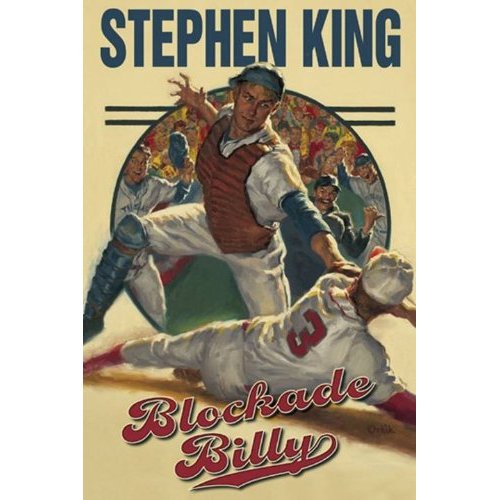
Blockade Billy, the star rookie catcher, turns out to be a serial killer. He's murdered the real Billy, and his family, and assumed his identity in order to get his chance in the show.
There's nothing supernatural about this story. Dirty tricks learned in his rough upbringing in an orphanage are one of the secrets of his success. But mostly, he's just very talented - much better at baseball than the real Billy. He's also just plain nuts. Everyone realizes this, but no one realizes how dangerous he is.
The ending is typically over the top. Blockade Billy takes the crowds' cries of "Kill the umpire!" literally, doing in the home plate umpire by slashing his throat.
The part that's really hard to swallow is the aftermath. We're supposed to believe that no one remembers Blockade Billy because his records were expunged, and none of the games he played in counted. They made up all 20 games by playing doubleheaders.
I find that hard to believe. They've had players playing under false names before, and players who committed crimes, and the games still counted. And 20 games is a heck of a lot of make-up.
It's also impossible to believe that people wouldn't remember it. It's not like you could keep it a secret; at the very least, you'd have to explain why all the games had to be re-played. It doesn't matter that the game was more local back then. A serial killer like Billy would be big news. Eddie Gein was big news in the '50s and is still remembered today, and Blockade Billy would have been, too.
But then, I guess Stephen King isn't exactly known for the believability of his stories. All in all, I would recommend this book for a baseball fan. It's rather overpriced for such a short work, but baseball fans will enjoy it.

I wasn't born when Bobby Thomson hit the shot heard 'round the world. I can't remember even hearing about it before reading this book, to tell you the truth. But then, I wasn't raised in a baseball family. (I have heard about the supposedly less famous Bill Mazeroski Game 7 walkoff homer...but that game involved the Yankees. So perhaps my knowledge of baseball history is a bit Yankee-centric.)
Surprisingly, no one knows what happened to Thomson's home run ball after it cleared the fence. Miracle Ball: My Hunt for the Shot Heard 'Round the World
It's a fascinating, though flawed book. It seems to be a sort of afterthought to Biegel's film, which tells the same story. The structure and style of the book seems better suited to a film than a book.
It's not a long book; I read it in about the time it takes to play a baseball game. But there's a lot going on it. There's the personal story, where Biegel details his struggles with depression and panic attacks, and describes how his family helped him, and how he tried to help them in return. There's the historical story, which paints a picture of what New York was like in 1951. And there's there the mystery: what really happened to the ball? It's perhaps too much to cram into such a small book, at least for this particular author.
The personal story is the weakest. Biegel's style is probably well-suited for documentaries and sports journalism, but seems rather flat and superficial for his personal struggles. He breezes over the account of his mental illness and recovery so perfunctorily it trivializes them. They become a distraction, taking away from the story rather than adding to it. The constant me, me, me also got a bit tiresome. (Though perhaps he felt he had to include that, since until the very end, he wasn't sure the mystery would be solved. If it wasn't, than the story of his personal redemption would have to carry the book.)
The history is more interesting. I suspect New Yorkers old enough to remember the era get the most out of it; for them, it's an evocative nostalgia trip. But it's also interesting for the rest of us.
Of course I knew things were different back in 1951, but this book drove home how those differences affected people. TV was brand new; one reason "The shot heard round the world" was so affecting was that it was one of the first games aired on national television. Baseball games, even playoff games and the World Series, were played during the day, which meant torture for fans who had to be in school or at work. There were many local newspapers, and the style of morning and evening papers were different. (This would turn out to be an element in the mystery.) There were no digital cameras back then; instead, one plate at time was loaded into the huge, bulky camera. The photographer had to choose his moment carefully, because it took so long to re-load the camera that there would be no second chance to get the shot. (Surprisingly, the photographer who took the iconic shot of the event didn't get a cent, at least in his lifetime.)
Baseball also mattered to people much more then. It truly was America's pastime, and the various people Biegel encounters during his quest all seem to remember exactly what they were doing when Thomson hit that historic home run. Some remembered it as the happiest moment in their lives. Some were scarred for life. Some were led to their life's vocation. It's hard to imagine any baseball event being so affecting today. There are too many teams, too many games, too much baseball coverage, for any one game to carry such weight.
Biegel introduces the major characters in the book with a short biography, describing what role the shot heard 'round the world played in each one's life. This is interesting at first, but gets tedious after awhile. The gimmick might work better in the film (which I haven't seen, but would like to). Or maybe I just got impatient, as the mystery grew more compelling.
The mystery is by far the best part. That's what pulled me through the book at breakneck speed. It's what makes it worth putting up with the book's flaws. The twists and turns Biegel encounters while searching for the ball are incredible. Everything from forensic analysis of a photo found in a flea market to a comment by an anonymous man at a Shop-Rite play a role. Promising leads turn into dead ends, and new clues arrive just when all seems hopeless. Truth really is stranger than fiction.
In fact, some of the coincidences seem so improbable that I can't help wondering if the story has been embellished somewhat. Even if it has, it's a great story. I don't want to spoil the ending, but you won't feel cheated by it. Biegel makes a good case for what happened to the ball and why it stayed hidden so long. I don't think his case for where the ball is now is as solid, but that's a minor matter. Just about any baseball fan will enjoy this book.
Not much going on baseball land today, it being Sunday, and a big day for the NFL. I could blog about today's playoff games, I suppose, but I'm just too depressed after the Cowboys' early exit. 
Other bloggers blog about pop culture on slow days: music, movies, TV shows, books. But my taste in music is boringly bourgeois, I rarely go to the movies, and I watch mostly news and sports on TV. That leaves books. I do like to read, and these days, my taste runs heavily towards science. (Why yes, I am nerd. ;-) I'm reading a truly fascinating science book right now - one that I think will prove to be tremendously important. But it's not much to do with baseball. You've been warned. I'm drifting off-topic today.
The book is Good Calories, Bad Calories
Taubes first broached the idea that low-fat diets might actually be bad for you in a 2002 NY Times article called What if It's All Been a Big Fat Lie? Now he's come out with an entire book on the topic, and it's a masterpiece.
Good Calories, Bad Calories argues, persuasively, that we've been seriously misled over the past 30 or 40 years. It was with the best of intentions - but wrong. Doctors were so eager to help people that they got ahead of the science.
There's more and more evidence that, contrary to what we've been told, it's not dietary fat that causes obesity, cancer, and heart disease. Rather, the problem is carbohydrates - especially refined carbohydrates like sugar, white flour, rice, and pasta.
This is an astonishing claim, but Taubes has the evidence to back it up, and he lays it out in detail. So much of what I thought was proven science on nutrition turns out to be built on shaky ground indeed. Fiber doesn't prevent colon cancer. Fat isn't bad for you - not even saturated fat. High cholesterol, even "bad" cholesterol, isn't the cause of heart disease. The "Mediterranean Diet" may be healthful because it is low in refined carbohydrates, not because it's high in vegetables and olive oil.
How did they get it so wrong? A lot of it has to do with the problems that come with science that involves people's health. There are limits on what kinds of experiments you can do on humans. And animals may not be good stand-ins. (For example, one of the early influential cholesterol studies used rabbits. But rabbits are herbivores. They don't normally eat cholesterol.) Many of the early researchers were doctors, not scientists; they did not know how to properly design studies. And they were so eager to save lives, that they felt they couldn't wait for proof.
But perhaps the greatest factor was mistaking correlation for causation. The classic example of this logic error: claiming that people going through the revolving doors of Macy's department store power the escalator inside. The proof? When you look inside the store when the doors are locked, the escalator is no longer moving!
Similarly, many of the studies of diet and health found a correlation, but did not prove causation. In particular, fat and meat consumption often go up with sugar consumption, so it's hard to say which one is the cause of health problems. Also, for international studies, many of the populations that ate a lot of carbs and not much meat and fat were chronically undernourished. (It's known now that calorie restriction can prolong life. But it's not easy to half-starve yourself your whole life - and maybe, if you eat the right kinds of calories, it's not necessary.)
There was also a lot of "confirmation bias" - the human tendency to interpret data in the light of one's preconceptions, and ignore anything that doesn't fit. An example was a study that clearly showed that high cholesterol was not linked with heart disease, but low cholesterol was strongly linked with cancer. That so contradicted expectations that the researchers simply refused to believe it.
If Taubes is right, then what we've been told for the past 30 years or so is the opposite of what we should be doing. I don't know if he's right or not, but intuitively, I suspect he's onto something. There are so many things that make sense in the light of his work. The so-called "French paradox": the French have fewer heart attacks than Americans, despite eating a lot more butter and cream, and smoking more. That Inuit eating their native diet of red meat and blubber don't get heart disease (and no, it's not fish oil). That Americans have gotten fatter, despite cutting back on fat and red meat, and eating more carbs. The fact that farmers who want to fatten their hogs feed them skim milk; they don't get fat if you feed them whole milk.
Back in the '50s and earlier, it was common knowledge that sweets and starches were what caused weight gain. The "diet plate" offered at restaurants was a hamburger patty, with a scoop of cottage cheese instead of a bun, and no fries. Maybe grandma was right after all...
Labels: books, off-topic, reviews, science of sports