Bubba Links
Baseball Links
Because how can you not love a baseball player named "Bubba"?
The New York Times published this excerpt from a book called The Price of Everything: Solving the Mystery of Why We Pay What We Do
IN 1990, the Kansas City Royals had the heftiest payroll in Major League Baseball: almost $24 million. A typical player for the New York Yankees, which had some of the most expensive players in the game at the time, earned less than $450,000.
Last season, the Yankees spent $206 million on players, more than five times the payroll of the Royals 20 years ago, even after accounting for inflation. The Yankees’ median salary was $5.5 million, seven times the 1990 figure, inflation-adjusted.
What is most striking is how the Yankees have outstripped the rest of the league. Two decades ago. the Royals’ payroll was about three times as big as that of the Chicago White Sox, the cheapest major-league team at the time. Last season, the Yankees spent about six times as much as the Pittsburgh Pirates, who had the most inexpensive roster.
Baseball aficionados might conclude that all of this points to some pernicious new trend in the market for top players. But this is not specific to baseball, or even to sport. Consider the market for pop music. In 1982, the top 1 percent of pop stars, in terms of pay, raked in 26 percent of concert ticket revenue. In 2003, that top percentage of stars — names like Justin Timberlake, Christina Aguilera or 50 Cent — was taking 56 percent of the concert pie.
Labels: books
I enjoy Stephen King, but I wouldn't call myself a diehard fan of his work. I'm not the type who pre-orders his books as soon as they are available, or camps out in front of book stores to buy them hot off the presses. I'm a casual reader. I don't read everything he writes, and usually wait until the book is in paperback.
However, being a baseball fan, I had to read Blockade Billy
King did get the baseball part right. It rings true, especially since he uses real players and places mixed in with the fictional ones. You can believe that ballplayers of that era really talked that way, and that it really was like that inside the locker room.
The actual story was kind of weak. I mean, it was interesting, but it was very short, and didn't really hold together if you think about it.
I find I can't discuss it without spoilers. If you don't want to know, bail out now. SPOILER WARNING!
I repeat, SPOILER WARNING! SPOILERS down below!
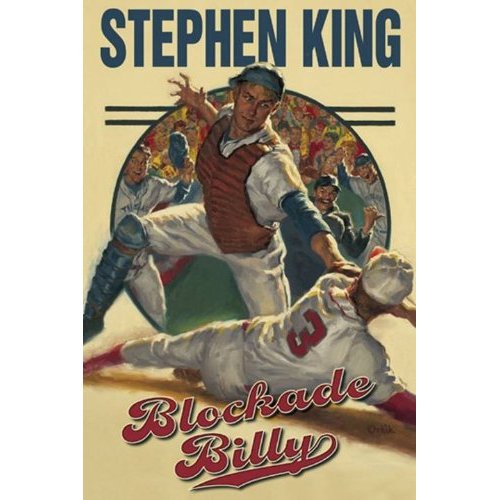
Blockade Billy, the star rookie catcher, turns out to be a serial killer. He's murdered the real Billy, and his family, and assumed his identity in order to get his chance in the show.
There's nothing supernatural about this story. Dirty tricks learned in his rough upbringing in an orphanage are one of the secrets of his success. But mostly, he's just very talented - much better at baseball than the real Billy. He's also just plain nuts. Everyone realizes this, but no one realizes how dangerous he is.
The ending is typically over the top. Blockade Billy takes the crowds' cries of "Kill the umpire!" literally, doing in the home plate umpire by slashing his throat.
The part that's really hard to swallow is the aftermath. We're supposed to believe that no one remembers Blockade Billy because his records were expunged, and none of the games he played in counted. They made up all 20 games by playing doubleheaders.
I find that hard to believe. They've had players playing under false names before, and players who committed crimes, and the games still counted. And 20 games is a heck of a lot of make-up.
It's also impossible to believe that people wouldn't remember it. It's not like you could keep it a secret; at the very least, you'd have to explain why all the games had to be re-played. It doesn't matter that the game was more local back then. A serial killer like Billy would be big news. Eddie Gein was big news in the '50s and is still remembered today, and Blockade Billy would have been, too.
But then, I guess Stephen King isn't exactly known for the believability of his stories. All in all, I would recommend this book for a baseball fan. It's rather overpriced for such a short work, but baseball fans will enjoy it.

I wasn't born when Bobby Thomson hit the shot heard 'round the world. I can't remember even hearing about it before reading this book, to tell you the truth. But then, I wasn't raised in a baseball family. (I have heard about the supposedly less famous Bill Mazeroski Game 7 walkoff homer...but that game involved the Yankees. So perhaps my knowledge of baseball history is a bit Yankee-centric.)
Surprisingly, no one knows what happened to Thomson's home run ball after it cleared the fence. Miracle Ball: My Hunt for the Shot Heard 'Round the World
It's a fascinating, though flawed book. It seems to be a sort of afterthought to Biegel's film, which tells the same story. The structure and style of the book seems better suited to a film than a book.
It's not a long book; I read it in about the time it takes to play a baseball game. But there's a lot going on it. There's the personal story, where Biegel details his struggles with depression and panic attacks, and describes how his family helped him, and how he tried to help them in return. There's the historical story, which paints a picture of what New York was like in 1951. And there's there the mystery: what really happened to the ball? It's perhaps too much to cram into such a small book, at least for this particular author.
The personal story is the weakest. Biegel's style is probably well-suited for documentaries and sports journalism, but seems rather flat and superficial for his personal struggles. He breezes over the account of his mental illness and recovery so perfunctorily it trivializes them. They become a distraction, taking away from the story rather than adding to it. The constant me, me, me also got a bit tiresome. (Though perhaps he felt he had to include that, since until the very end, he wasn't sure the mystery would be solved. If it wasn't, than the story of his personal redemption would have to carry the book.)
The history is more interesting. I suspect New Yorkers old enough to remember the era get the most out of it; for them, it's an evocative nostalgia trip. But it's also interesting for the rest of us.
Of course I knew things were different back in 1951, but this book drove home how those differences affected people. TV was brand new; one reason "The shot heard round the world" was so affecting was that it was one of the first games aired on national television. Baseball games, even playoff games and the World Series, were played during the day, which meant torture for fans who had to be in school or at work. There were many local newspapers, and the style of morning and evening papers were different. (This would turn out to be an element in the mystery.) There were no digital cameras back then; instead, one plate at time was loaded into the huge, bulky camera. The photographer had to choose his moment carefully, because it took so long to re-load the camera that there would be no second chance to get the shot. (Surprisingly, the photographer who took the iconic shot of the event didn't get a cent, at least in his lifetime.)
Baseball also mattered to people much more then. It truly was America's pastime, and the various people Biegel encounters during his quest all seem to remember exactly what they were doing when Thomson hit that historic home run. Some remembered it as the happiest moment in their lives. Some were scarred for life. Some were led to their life's vocation. It's hard to imagine any baseball event being so affecting today. There are too many teams, too many games, too much baseball coverage, for any one game to carry such weight.
Biegel introduces the major characters in the book with a short biography, describing what role the shot heard 'round the world played in each one's life. This is interesting at first, but gets tedious after awhile. The gimmick might work better in the film (which I haven't seen, but would like to). Or maybe I just got impatient, as the mystery grew more compelling.
The mystery is by far the best part. That's what pulled me through the book at breakneck speed. It's what makes it worth putting up with the book's flaws. The twists and turns Biegel encounters while searching for the ball are incredible. Everything from forensic analysis of a photo found in a flea market to a comment by an anonymous man at a Shop-Rite play a role. Promising leads turn into dead ends, and new clues arrive just when all seems hopeless. Truth really is stranger than fiction.
In fact, some of the coincidences seem so improbable that I can't help wondering if the story has been embellished somewhat. Even if it has, it's a great story. I don't want to spoil the ending, but you won't feel cheated by it. Biegel makes a good case for what happened to the ball and why it stayed hidden so long. I don't think his case for where the ball is now is as solid, but that's a minor matter. Just about any baseball fan will enjoy this book.

The baseball world is abuzz over The Yankee Years
The New York Times review by Michiko Kakutani suggests that what went wrong with the Yankees was exactly what fans have been complaining about for years:
The hallmark of the Yankees who won World Series championships in 1996, 1998, 1999 and 2000 was gritty team play: they weren’t famous for a roster of flashy superstars or power hitters; rather, they were a resolute band of brothers, who put collective play above individual stats — an ensemble distinguished by its chemistry on the field and in the clubhouse, a team renowned for its resourcefulness, its determination and its ability to grind out win after win after win.
...Torre and Verducci note that as the core of the old guard from the championship years dwindled — Tino Martinez, Scott Brosius, Chuck Knoblauch and Paul O’Neill were all history by 2002 — the front office tended to turn to imported All-Stars, who failed to congeal into an effective ensemble. The farm system, which had produced the likes of Derek Jeter, Jorge Posada, Bernie Williams and Rivera, was increasingly neglected, and Steinbrenner began to indulge his taste for what Torre calls “big boppers” like Jason Giambi, who the manager felt “wasn’t part of what we prided ourselves on: playing well defensively.”
Labels: books
It's the Renaissance Vinoy Hotel in St. Petersburg, Florida. (The most haunted baseball field is also in St. Petersburg: Huggins-Stengel Field). According to Haunted Baseball, the Vinoy has such a spooky reputation that some players refuse to stay there.
One who believes the hotel is haunted is relief pitcher Scott Williamson...
Today the Vinoy is the visiting team hotel for the Tampa Bay Devil Rays.
But movie stars and ballplayers are not the most famous guests at the Vinoy - ghosts are. While some in baseball openly poke fun at the hotel's numerous sightings, for many the fear of uninvited room guests is no laughing matter.
Relief pitcher Scott Williamson had never heard of the Vinoy being haunted when he stayed in an old section of the hotel with the Cincinnati Reds in mid-June 2003. But he ended up with an experience he says he'll never forget. "I turned the lights out and I saw this faint light coming from the pool area. And I got this tingling sensation going through my body like someone was watching me, you know? I was getting a little paranoid.
"Then I roll over to my stomach. And all of a sudden it felt like someone was just pushing down, like this pressure, and I was having trouble breathing. So I rolled back over. I thought, 'That's weird.' I did it again, rolled back on my stomach. All of a sudden, it's like I just couldn't breathe. It felt like someone was sitting on me or something."
This time when Williamson rolled onto his back, he opened his eyes. "I looked, and someone was standing right where the curtains were. A guy with a coat. And it looked like he was from the '40s, or '50s, or '30s-somewhere around that era."
Williamson called his wife Lisa, who worked in an emergency room, and asked if there could be a medical reason for the heaviness on his chest. "She went through all the things that could happen, but obviously hadn't happened. She said 'Why?' And I said, 'I tell ya, the weirdest thing just happened to me.' I told her the whole story."
"ESPN caught onto the story the next day," adds Williamson. "And then a buddy of mine went and did research on it. He came back and told me, 'You're not gonna believe this! There's a guy who died in that hotel. His name was Williamson. He actually owned the hotel property before it was a hotel.' He's going through this whole thing about a fire and all this stuff. I'm like, 'What's his last name?' He goes 'Williamson.' I was like, 'You gotta be kidding me!'"

Not much going on baseball land today, it being Sunday, and a big day for the NFL. I could blog about today's playoff games, I suppose, but I'm just too depressed after the Cowboys' early exit. 
Other bloggers blog about pop culture on slow days: music, movies, TV shows, books. But my taste in music is boringly bourgeois, I rarely go to the movies, and I watch mostly news and sports on TV. That leaves books. I do like to read, and these days, my taste runs heavily towards science. (Why yes, I am nerd. ;-) I'm reading a truly fascinating science book right now - one that I think will prove to be tremendously important. But it's not much to do with baseball. You've been warned. I'm drifting off-topic today.
The book is Good Calories, Bad Calories
Taubes first broached the idea that low-fat diets might actually be bad for you in a 2002 NY Times article called What if It's All Been a Big Fat Lie? Now he's come out with an entire book on the topic, and it's a masterpiece.
Good Calories, Bad Calories argues, persuasively, that we've been seriously misled over the past 30 or 40 years. It was with the best of intentions - but wrong. Doctors were so eager to help people that they got ahead of the science.
There's more and more evidence that, contrary to what we've been told, it's not dietary fat that causes obesity, cancer, and heart disease. Rather, the problem is carbohydrates - especially refined carbohydrates like sugar, white flour, rice, and pasta.
This is an astonishing claim, but Taubes has the evidence to back it up, and he lays it out in detail. So much of what I thought was proven science on nutrition turns out to be built on shaky ground indeed. Fiber doesn't prevent colon cancer. Fat isn't bad for you - not even saturated fat. High cholesterol, even "bad" cholesterol, isn't the cause of heart disease. The "Mediterranean Diet" may be healthful because it is low in refined carbohydrates, not because it's high in vegetables and olive oil.
How did they get it so wrong? A lot of it has to do with the problems that come with science that involves people's health. There are limits on what kinds of experiments you can do on humans. And animals may not be good stand-ins. (For example, one of the early influential cholesterol studies used rabbits. But rabbits are herbivores. They don't normally eat cholesterol.) Many of the early researchers were doctors, not scientists; they did not know how to properly design studies. And they were so eager to save lives, that they felt they couldn't wait for proof.
But perhaps the greatest factor was mistaking correlation for causation. The classic example of this logic error: claiming that people going through the revolving doors of Macy's department store power the escalator inside. The proof? When you look inside the store when the doors are locked, the escalator is no longer moving!
Similarly, many of the studies of diet and health found a correlation, but did not prove causation. In particular, fat and meat consumption often go up with sugar consumption, so it's hard to say which one is the cause of health problems. Also, for international studies, many of the populations that ate a lot of carbs and not much meat and fat were chronically undernourished. (It's known now that calorie restriction can prolong life. But it's not easy to half-starve yourself your whole life - and maybe, if you eat the right kinds of calories, it's not necessary.)
There was also a lot of "confirmation bias" - the human tendency to interpret data in the light of one's preconceptions, and ignore anything that doesn't fit. An example was a study that clearly showed that high cholesterol was not linked with heart disease, but low cholesterol was strongly linked with cancer. That so contradicted expectations that the researchers simply refused to believe it.
If Taubes is right, then what we've been told for the past 30 years or so is the opposite of what we should be doing. I don't know if he's right or not, but intuitively, I suspect he's onto something. There are so many things that make sense in the light of his work. The so-called "French paradox": the French have fewer heart attacks than Americans, despite eating a lot more butter and cream, and smoking more. That Inuit eating their native diet of red meat and blubber don't get heart disease (and no, it's not fish oil). That Americans have gotten fatter, despite cutting back on fat and red meat, and eating more carbs. The fact that farmers who want to fatten their hogs feed them skim milk; they don't get fat if you feed them whole milk.
Back in the '50s and earlier, it was common knowledge that sweets and starches were what caused weight gain. The "diet plate" offered at restaurants was a hamburger patty, with a scoop of cottage cheese instead of a bun, and no fries. Maybe grandma was right after all...
Labels: books, off-topic, reviews, science of sports

 , it's Huggins-Stengel Field, in St. Petersburg, Florida. It was the Yankees spring training facility for years. The Mets, the Orioles, Devil Rays, and Cardinals also used the field.
This is an excerpt from a book called Haunted Baseball
Among those lost on September 11 was firefighter Kenny Marino. A lifelong baseball fan, Marino played local ball, was an avid Strat-O-Matic junkie, and rooted like crazy for the Mets. When he was killed in the World Trade Center attacks, his obituary in the New York Times was headlined: KENNY MARINO. A DEVOUT BASEBALL FAN. At the end of a memorial service for him, members of his Rescue I fire squad led a mourning procession to the organist's rendition of "Take Me Out to the Ball Game."
"We used to have a running joke," says his wife Katrina Marino. "His list of favorite things. Firefighting, baseball, the kids...and then me!"
Though not a baseball fan herself, Katrina didn't really mind sharing her husband with his boyhood passion. "I was pretty easy-going about it, because it's such an innocent, sweet, good sport, you know? I encouraged it."
When it came to his favorite player, there was no contest. Kenny Marino considered himself the world's biggest Ken Griffey Jr. fan. "He followed him since he was a rookie," says Katrina. Marino had Griffey on all his fantasy league teams. The only picture in the couple's bedroom was of Griffey. When their son was born, he was given the middle name "Ken" - not just because it happened to be Marino's first name.
"He wanted it more because of that - because of Junior - than his own namesake," Katrina says with a laugh.
Early in their relationship, Katrina, then a flight attendant, flew Ken out to Seattle for a Mariner's game. Marino got to the park early to see his idol. He didn't speak to Griffey ("He was kind of quiet," Katrina explains), but he got close enough to pass the slugger a present he'd brought along for his son Trey: an FDNY
T-shirt.
In the aftermath of the attacks, Katrina Marino "was in a tailspin. I didn't know which end was up." On September 24, she went online using her husband's account. "I just remember feeling like I wanted to connect somehow," she says. She immediately got messages from Kenny's Strat-O-Matic buddies, who saw the e-mail address and hoped it was their friend.
Perhaps that was what spurred her to send an e-mail to the Cincinnati Reds.
Ken Griffey Jr. was my husband's favorite baseball player, she wrote. If Ken Griffey Jr. could hit an extra home run for Ken, I know he will be looking down with a big grin.
"And I kinda just left it at that," she recalls. "I didn't think anyone would get it. I was just kind of reaching out in general." Katrina had no great designs on invoking any kind of spirit. "I don't really believe in the supernatural. Another life. I wasn't sure. But I thought, 'Well maybe if he sees it, or if he's around...,' you know?"
The e-mail made its way to Rob Butcher, the team's director of media relations. He showed it to Junior shortly before the game.
The 200I season was not one of Ken Griffey Jr.'s best. He sat out a third of the Reds games with injuries. After averaging nearly 50 home runs in the previous five seasons, he would hit only 22 that year. His RBI percentage drop was even greater.
In the week since baseball resumed, he was batting a mere .190. That night's game against Philadelphia seemed unlikely to turn things around: The Phillies were the only team he'd never homered against in his career. In fact, he'd never gotten a hit off them.
But in the fourth inning, having already singled his first time up, Junior got hold of a 1-0 pitch and sent it over the rightfield fence.
He hadn't been thinking of Kenny Marino when he stood at the plate, but says that "around first base, I realized what happened. I was just shocked. Things like that don't normally happen to me." More than anything, Griffey was happy for the family. He had no explanation for what he did, other than a belief that God had him hit one out for the Marinos.
Back in Monroe, New York, Katrina had been too busy dealing with the tragedy to follow the game. That day in particular had been one of the worst. "I went down into the city. We had to bring in DNA stuff [to help identify remains], like his razor, and toothbrush - whatever we could find. So I had been down there all day filling out all this awful paperwork. "
"Then I came back and the phone rang. And someone said, 'Do you know that Ken Griffey Jr.'s just hit the home run for your husband?' And I'm like, 'No! We didn't know that!' And it was pretty neat."
It gave Katrina a small ray of happiness in the midst of some very dark days.
"Everything around that time was just so...surreal. I think I said something like 'Well, I know Kenny's looking down smiling.' Because he had the biggest grin. Especially for something like that. I had a warm feeling like, I know that he saw that. I know that."
Katrina also appreciated the special home run as something her son and daughter - just one and three years old at the time - would always remember: a connection to their father, through the sport that he loved.
"He would throw balls at three-month-old Tyler," she recalls. "He couldn't wait to play ball with them. He wanted to be their coach; he wanted to teach them how to play. And I definitely feel that's one thing I haven't been able to give them," she says. She then adds with a laugh, "He might be a little angry at me!"
The Reds invited Katrina and the kids to attend a game and receive the home-run bat, but the timing was difficult. "Around that time, I didn't know if Kenny was going to be found, and flying was really hazardous.") Instead, the team sent her the bat. The following year, she met Junior for the first time at a game at Shea. "I have a picture of my kids climbing all over his back. He threw a ball with them. He's just a genuinely nice guy," she says.
Griffey had another surprise for Katrina. He still had the FDNY T-shirt Kenny had given him years earlier.
The Marinos did eventually make a trip to Cincinnati, where Junior again met with them. In 2004, when Griffey hit home run number 500 on Father's Day, he wore two armbands, one blue and one black. He sent the black one to the Hall of Fame. "He gave us the blue one, which is actually Rescue 1's color," says Katrina fondly.
The whole experience has Katrina rethinking her ideas about what lies beyond.
"I don't usually believe in that stuff, but I started kind of believing in certain things," she says. "When I went to the park and met Ken Griffey Jr. that first time, we were on the field and I remember standing out there feeling so lost. And I started tearing up. I don't cry very often. I don't usually go there. And I remember thinking, This is Kenny's moment. He knows all these guys. He would appreciate who every single person is. He would appreciate knowing all their scores and stats, and how many hits they had. And I thought, 'I hope he can see this. Because this is his moment.'"
For Griffey, the homer he hit for Kenny Marino will be "in the top five" of all his dingers.
"This situation is bigger than baseball," he says. "There's not a day that I don't think of [the family]. He risked his life for other people. That's a hero. What I do, I just play baseball. I'm not a hero."
When Griffey sent the armband on Father's Day, his mind was on the Marino children. "I was thinking about their father that they lost. I don't want them to ever forget that."
For Katrina, the story is not about her, and not about Griffey. "It was more like giving something to Kenny. This is for you. Maybe he could see that, enjoy it, and appreciate it. It was more for him than it was ever for me. Just knowing the satisfaction that if Kenny was watching, he would see it."
9/11 REMEMBRANCE: On Tuesday, the Reds will host Katrina Marino and her kids, Kristin, 9, and Tyler, 7. On Sept. 25, 2001, Ken Griffey Jr. dedicated a home run in honor of Kenny Marino, husband and father, who was a Rescue 1 firefighter and died in the Twin Towers tragedy. Tyler will throw out the ceremonial first pitch and Griffey will catch it.
According to Haunted Baseball
It sounds pretty corny. They didn't believe it at first. There are similar rumors about almost every stadium: that it was built on an old graveyard, or a Native American burial ground, and is therefore haunted. It's almost never true. But in this case, research backed up the rumors. Tropicana Field was built over three former African-American cemeteries. The remains were supposed to be removed, but not all of them were. Every once in awhile, there are unpleasant surprises unearthed when excavation is done in the neighborhood.
Perhaps the most astounding thing was when they were building the parking lot, and a reporter asked a city official about the possibility of human remains being there. The city official said it would be okay; they weren't digging very deep, since it was only a parking lot. (!!!)
Anyways, the book gives Josh Hamilton a brief mention. Part of the curse is supposedly that few of their prospects work out, and Hamilton's drug and injury problems are listed as part of the evidence.
If so, maybe getting away from Tampa Bay is the cure for him. Though he's been a little cursed this week. The other day, he got an error when he charged a ground ball and somehow missed it. And he gave away a three-run homer, when a ball bounced out of his glove and over the wall. Then yesterday, he had plenty of time to set up under a flyball, but missed it. It wasn't really his fault; the ball just changed course in midair. Weird topspin? A swirl of wind? Or the curse?
The Yankees were also a little cursed yesterday. But I wasn't surprised. It's the bleepin' Halos. To make things worse, the game went to extra innings, which means it ended about 2am.
The Yankees lost on a walkoff single by the Angels' rookie catcher. It was only his second big league hit ever. The play reminded many of the collision between Bubba and Sheff in 2005.
I didn't think it was that similar. The ball did drop into the no-man's land between CF and RF, but there was no collision. Neither Melky nor Abreu could get to it. Perhaps they were a little distracted, fearing a collision. (Hah. Bubba would probably have gotten to it. He's faster than Melky, and fearless. Not quite Ryan Freel fearless, but up there.)
And the Sox won, so the Yanks are once again five games back.
There's a new book out, called Haunted Baseball. It was originally scheduled to be published around Halloween, but I guess they moved it up, because my pre-order from Amazon
The authors interviewed hundreds of players and managers, asking them to share their true ghost stories. It's as much about baseball tradition and history, and the fun and camaraderie of baseball life, as about ghosts.
There's a lot of great stuff in it, and I'll probably write a proper review of it later.
In the meantime, here's one of the stories. It has both a Yankees and a Reds connection, since it involves recent Reds manager Jerry Narron, back when he was a young catcher for the Yankees.
Unsafe at Home
While pitching for the Yankees in the late 1970s, [Ron] Davis shared a home in Dumont, New Jersey, with catcher Jerry Narron. "We didn't have any money," recalls Davis. "Minimum wage was $19,000." A Realtor friend offered an abandoned house that was going to be torn down at the end of the year. The ballplayers could live in it for free.
The house had been empty for a while and was creepy. "It had no water, no gas. We had Coleman stoves we were cooking on," recalls Davis. "We used a skeleton key to open the door." Millie Davis - the pitcher's girlfriend at the time, who would eventually become his first wife - never felt comfortable in the house. "I think it was condemned," she says. "It was old and dusty and scary." She tried to brighten the place up, but "no matter what I did to it, it just always looked spooky and creaky and scary as hell. That place gave me the creeps." The very first night the couple spent there was marked by a ghostly event. They got home late from a game and climbed the stairs to the bedroom. Entering, Millie reached up for a light switch in the middle of the room. "Right as I reached my hand up, the window flew open," she says. On its own, the heavy wooden frame suddenly shot straight up, bringing in a gust of cool air. The couple was stunned. Ron turned and ran down the stairs, and Millie followed him. "You're leaving me here to get killed by the ghost?" she yelled.
"We never slept in that room again. We never went in that room again," she says. After the window incident, "I wouldn't even go upstairs to the bathroom by myself."
Ron tells an even scarier tale. One night, he claims, he, Millie, Narron, and Narron's girlfriend came home and were walking up the stairs when fire instantaneously broke out around them.
"Just flames in the hallway - everywhere in the hall," he says. The ballplayers ran out to the street, abandoning the women ("I said somebody's got to live to tell this story," Ron jokes) and called out for help. In time, the fire and police departments responded, but to everyone's surprise, "the fires went out." As quickly and mysteriously as they'd begun, the flames suddenly extinguished themselves.
"We went in and there was nothing burnt; there was nothing charred," says Davis. "No one could figure out anything." But eventually Davis did learn more about the house itself, and why it had been abandoned. "There was a family of five that was killed there," he says. "And no one would ever move into it."
Red Menace at RR mentioned that I should check out Sam Walker's book, Fantasyland
Fantasyland, as you might guess from the title, is about fantasy baseball. In particular, it's about a sports journalist who tries to use his connections to put together the killer fantasy team:
After scrolling past all the arms for hire, I reach the list of available outfielders, which, in addition to its alarming brevity, reads like a list of cabin assignments at a camp for fat kids.
Mendy Lopez
Simon Pond
Bubba Crosby
Lopez, of Kansas City, is quickly eliminated. Though he hit a home run on Opening Day, he's all but certainly headed to the minors. The next name, Toronto's Pond, is a mystery to me. All I know is that he put up some decent power numbers in winter ball. The third candidate, Crosby of the Yankees, is the most familiar, only because I'd been reading about him in the New York papers. After six long years in the minors, Bubba caught the attention of Yankees manager Joe Torre by hitting .357 at spring training and covering center field like a water spider. He'd been the last guy to make the team. Trouble was, Bubba hadn't played yet, and when a couple of injured teammates returned he was likely to be dropped.
The next day, forty hours after Dmitri Young broke his leg and one day before the first weekly FAAB deadline, I'm standing next to Bubba Crosby in the Yankees locker room. The first thing you notice about Crosby, other than the fact that there's not a grain of dirt on his uniform, is that he looks like somebody's lost kid brother. He might well be 5'-11" as the program states, but only in spikes.
Now that he's made the major-league team, Crosby tells me, he's trying to shorten his swing to focus on making contact and getting base hits.
He's determined to make things happen by taking walks, stealing bases, and scoring runs, rather than crushing the baseball into powder. If anything, he's given up on the idea of hitting a home run, which is exactly what we need until Young comes back. "I'm not gonna make any money in deep center field," he says.
The next day, with exactly one hour left to submit my free-agent bids, I still can't decide. Sig has no meaningful data on these subjects. Nando likes Crosby because of his torrid spring, but I'm leaning toward Simon Pond, only because he seems at least physically capable of hitting home runs.
To break the stalemate, I pick up the phone and call Joe Housey, a former pitcher who's now working as a scout for the Chicago Cubs. Built like a lumberjack with a gruff sense of humor, he's the kind of guy who slaps you on the back and nearly knocks you over. I know that he covers Florida, where he'd surely seen both Pond and Crosby at spring training. When I reach him, he's on the golf course.
"Not now," he says, "I'm on the tee."
"Ten seconds?"
"Okay, go ahead."
"What do you think of Simon Pond?"
"He stinks."
"What about Bubba Crosby?"
"He's better."
"Thanks, Joe."
Hanging up, I type an e-mail to Commissioner Liebowitz and bid $1 of my $100 budget for Bubba Crosby. Minutes later, Crosby is a member of the Streetwalkers. Mine was the only bid.
About two hours later on Friday evening, the White Sox are thumping the Yankees in the Bronx. In the ninth inning, with the outcome all but certain, manager Joe Torre sends our man Bubba Crosby out for his first swing as a Yankee. With teammate Hideki Matsui on second base, Crosby shuffles to the plate, looking as if he'd just finished breathing into a paper bag. With one ball and two strikes, he uncoils his bat and belts a fly ball to right field that, to the surprise of everybody on earth, clears the fence.
Home run, Bubba.
He's not the first Yankee to homer on his first trip to the plate, but he's got to be the most unlikely. Circling the bases, Crosby runs so fast he nearly slams into Matsui's back. "I was just trying to calm myself down," he tells reporters after the game. "Being a rookie and playing in New York, my heart was racing." SportsCenter features a highlight of Bubba's blast, followed by a graphic comparing his relatively paltry $301,000 salary to the millions earned by teammates Jeter, Giambi, and Rodriguez.
As a reward for Crosby's Friday miracle, Torre puts him in the lineup on Sunday. It's his first start in pinstripes, and when he jogs out to center field the bleacher bums begin chanting his name. Inspired, Crosby makes a pair of spectacular catches, hurling himself against the outfield wall with abandon.
After grounding out on his first trip to the plate, Crosby comes to bat in the fourth inning with two runners on. He takes two balls from Chicago's Danny Wright and then, with a swing that nearly topples him, drives a ball through the damp April air that bounces off the facade of the upper deck in right field. Right before my eyes, the unwanted free-agent outfielder I picked up for one lousy FAAB dollar is taking a curtain call at Yankee Stadium.
The next morning, I buy all the papers. The Times puts the story on the front of the sports section. The Bergen County Record calls Bubba an "instant sensation," and a New York Post headline shouts: "Hubba Bubba!" Gary Sheffield calls Bubba a "throwback." White Sox manager Ozzie Guillen describes him as "the new Babe Ruth in town," and Torre raves like a proud papa. "It seemed like every other inning I was tipping my cap," Crosby said. "This day's pretty much tattooed in my mind."
Crosby is the toast of Tout Wars, too. Hollywood Matt Berry praises my pickup in his nightly blog, and Lawr Michaels gives me props in a column on CREATIVESPORTS. "Keep up the good work!" says Rick Fogel. More important, Crosby's three-run home run vaults me up two places in the standings to seventh.
I'm quite aware Crosby isn't going to hit a home run in every game, let alone as many as a healthy Dmitri Young. There's still a chance he'll be back in the minors by the end of the month. But he's already given me something more important than a statistical boost: a new infusion of confidence. I'm going to be good at this game, because I know people.
Labels: books